A Pee Reminder App for Long Bathroom Gaps
A pee reminder app for when forgetting to pee is the problem, with an honest look at when you need fixed alarms and when gap-aware reminders are enough.
Last updated: September 2026
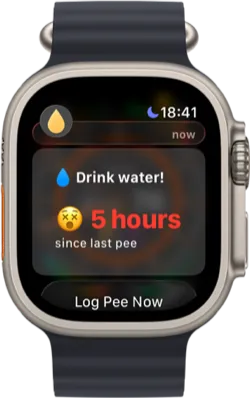
Meet P, a hydration app built around bathroom visits
P tracks when you use the bathroom, then uses that output pattern to support hydration awareness. Instead of logging every glass, you log it in seconds when you go and let the app track time since your last visit.
water reminder
interval
from Watch
Why you might need a pee reminder
Most people do not need an app to tell them every bathroom break. But some routines make body cues easy to ignore. A reminder can be useful when the problem is not tracking, but forgetting that time has passed.
- Hyperfocus or ADHD. Deep work, gaming, studying, and creative flow can push basic body signals into the background.
- Post-surgery timed voiding. Some people leave a clinic with specific instructions for timed bathroom visits. A wellness app can support logging, but it should not replace the schedule your clinician gave you.
- Bladder training for OAB. The AUA/SUFU 2024 guideline discusses behavioral approaches for overactive bladder, including bladder training and diaries. Use clinician guidance for the actual interval plan, and see our hydration and overactive bladder guide for related wellness context.
- Long shifts and work-from-home days. Nurses, drivers, teachers, gamers, and desk workers can go long stretches without noticing bathroom timing.
- Pregnancy. Holding urine for long periods can be uncomfortable, and hydration awareness may matter more. For UTI concerns, use medical guidance and see our hydration and UTI risk guide.
- Older adults. A structured daytime routine may help some people notice patterns around evening fluid timing and nighttime bathroom trips. Talk with a clinician if nocturia or sudden frequency changes are an issue.
The key distinction is intent. If you need exact reminders at 9:00, 11:00, and 1:00, use phone alarms or calendar reminders. If you need help noticing long gaps after your last logged visit, P’s reminder model is a better fit.

Reminders Keyed to Your Body
P times water reminders from your last bathroom visit, not an arbitrary schedule, and a tap is all it takes to log.

How P’s reminders work
P does not currently work like a generic alarm app where you create arbitrary bathroom reminders at fixed clock times. The verified reminder system is built around time since the last logged bathroom visit.
After you log a pee, P schedules water reminder notifications. The default first reminder is 3 hours after the last logged visit. After that, the default repeat interval is every 30 minutes, with hourly reminders in the sequence. The defaults work well for most people. With a subscription, you can adjust the first reminder delay between 1 and 5 hours and change the interval between reminders to 10, 20, 30 minutes, or hourly-only.
Quiet Hours prevent water reminders during the window you choose. Reminder notifications can include context such as time since last pee and averages when enough data is available. Notification actions can also help you log quickly if you forgot, including logging now, 30 minutes ago, or 60 minutes ago.
On Apple Watch, P includes a custom water reminder notification view and fast watch logging. When your iPhone and Watch notification settings route alerts to your wrist, the reminder can show up where you are most likely to notice it. See the Apple Watch water tracker guide for the Watch-first workflow.
Because this is a hydration and bathroom-pattern reminder, not a medical scheduler, it works best for general wellness and awareness. For post-surgery instructions, bladder training plans, or overactive bladder care, follow the schedule from your clinician and use P as a companion log if it fits your routine.
vs other reminder approaches
Different reminder tools solve different problems. The best choice depends on whether you need exact timed prompts, context after the prompt, or a record of what happened. If your routine is a catheterization schedule rather than a hydration nudge, the catheter reminder app guide covers that use case.
| Approach | Best for | Tradeoff |
|---|---|---|
| Phone alarms | Strict schedules such as every 2 hours or exact post-surgery times. | Strong for timing, weak for logging and history unless you maintain a separate record. |
| Calendar events | Clinician-provided schedules that need dates, times, and repeat rules. | Good structure, but easy to dismiss without recording whether you went. |
| Generic reminder apps | Simple nudges such as “take a bathroom break” during work hours. | Flexible, but disconnected from your actual bathroom history. |
| P | Gap-aware reminders based on time since your last logged bathroom visit. | Not a fixed alarm scheduler. Stronger when you want the prompt and the log in one habit loop. |
The dedicated-app advantage is context. P knows when you last logged a bathroom visit, so the reminder is tied to the habit you are trying to notice. That makes it different from a repeating alarm that fires whether you went 10 minutes ago or 4 hours ago.
A BMJ study on paper vs electronic diaries found a large gap between reported paper-diary compliance and actual compliance. The lesson for bathroom tracking is practical: the easier the logging step, the more likely the record reflects reality.
Looking to track instead of be reminded?
If your goal is logging every visit (for a doctor, a voiding diary, or a frequency baseline), the right page is P as a pee tracker. That page focuses on output logging and what your visit frequency reveals about your health. This page focuses on the gap-aware alerts that nudge you to drink water before you fall behind.
Research context for bathroom frequency
Bathroom reminders should stay modest in their claims. P is a general wellness app, not a medical device. The research below supports why bathroom frequency can be meaningful for hydration awareness and why easier logging can matter.
Try gap-aware bathroom reminders
Download P, log each bathroom visit in seconds, and let reminders follow the time since your last logged visit. Use fixed alarms too if your schedule requires exact times.
Frequently Asked Questions
Some people ignore body cues during hyperfocus, long shifts, gaming, driving, or deep work. P is not a fixed bathroom-alarm scheduler, but it can help you notice long gaps by sending water reminders based on how long it has been since your last logged bathroom visit.
Most healthy adults urinate 6 to 10 times per day. Research shows well-hydrated individuals average 7 plus or minus 2 bathroom visits during waking hours, while fewer than 6 visits suggests suboptimal hydration. Frequency outside this range, especially sudden changes, is worth discussing with a doctor. P tracks your personal patterns over time so you and your healthcare provider can see what is normal for you.
Yes. When your iPhone and Apple Watch notification settings allow it, P water reminders can appear on Apple Watch, and the Watch app includes a custom water reminder view. P also supports fast Watch logging, so a reminder can lead directly into a quick bathroom-visit log.
No. P is designed as a general wellness app for adults who want hydration awareness and bathroom-visit logging. It is not built for children, potty training, or caregiver-managed toileting programs.
No. P is a general wellness app, not a medical device. It does not diagnose, treat, cure, mitigate, or prevent bladder conditions. If you have overactive bladder, post-surgery instructions, pregnancy concerns, recurrent UTIs, pain, blood in urine, or sudden changes in frequency, follow your clinician’s advice.
This page summarizes general wellness use cases and peer-reviewed research for educational purposes. P is not a medical device and does not provide diagnosis, treatment, cure, mitigation, or disease prevention. Follow professional medical advice for bladder conditions, surgery recovery, pregnancy concerns, pain, blood in urine, or sudden changes.